


 English
 Español
 عربى
عربىContent
- 1 Material Safety and Certification Framework
- 2 How Injection Molding Determines Cup Lid Quality
- 3 Sealing and Leak-Proof Performance Analysis
- 4 Customization Service Capabilities
- 5 Application Scenarios and Market Demand
- 6 Environmental Attributes and Sustainable Development
- 7 Procurement and Usage Recommendations
PP injection molded cup lids have become the dominant solution for coffee, milk tea, and juice packaging, thanks to their food-grade safety certifications, superior leak-proof sealing performance, and extensive customization capabilities. Manufactured from polypropylene (PP) through precision injection molding, these lids maintain stable performance across a temperature range of -20°C to 120°C, meeting the full-spectrum demands of both hot and cold beverage packaging.
Material Safety and Certification Framework
Food-Grade Raw Material Standards
PP injection molded cup lids are produced from 100% virgin polypropylene resin, a material inherently non-toxic and odorless, free from bisphenol A (BPA) and other harmful substances. Premium PP cup lids typically carry the following authoritative certifications:
- German DIN Food Safety Certification — stringent limits on material migration levels
- EU ROHS+ Testing — ensures absence of lead, cadmium, and other heavy metals or hazardous chemicals
- QS National Industrial Product Production License — mandatory access standard for China's packaging industry
- ISO 9001 Quality Management System Certification — covers full-process control from raw material procurement to finished product dispatch
Temperature Tolerance and Usage Safety
PP material has a melting point of approximately 160°C to 170°C and a heat deflection temperature above 100°C, enabling PP injection molded cup lids to safely contact hot beverages up to 120°C. In practical applications, hot beverage lids are typically designed to tolerate temperatures between 90°C and 100°C, while cold beverage lids retain excellent toughness and sealing integrity at temperatures as low as -20°C without becoming brittle or cracking.
How Injection Molding Determines Cup Lid Quality
Key Technical Aspects of Precision Injection Molding
PP injection molded cup lids are manufactured using high-precision molds and automated production lines, where critical process parameters directly impact finished product quality. Typical injection molding control indicators include:
| Process Parameter | Typical Setting Range | Impact on Quality |
|---|---|---|
| Barrel Temperature | 180°C - 230°C | Insufficient temperature causes incomplete filling; excessive temperature leads to material degradation |
| Mold Temperature | 40°C - 80°C | Affects surface finish quality and dimensional stability |
| Injection Pressure | 80 - 150 MPa | Determines wall thickness uniformity and detail replication accuracy |
| Holding Pressure Time | 2 - 8 seconds | Prevents sink marks and ensures sealing surface flatness |
| Cooling Time | 10 - 20 seconds | Influences molding cycle time and product warpage rate |
Critical Quality Inspection Indicators
Pre-dispatch quality inspection serves as the final safeguard for ensuring cup lid performance. Primary inspection items include sealing tests (simulating leak resistance under tilting and inversion conditions), dimensional accuracy checks (fit tolerance between lid and cup rim typically controlled within ±0.2mm), drop tests (no breakage after free fall from 1 meter height), and hygiene indicator testing (microbial limits, evaporation residue, etc.). Through comprehensive quality control, premium PP injection molded cup lids achieve a first-pass yield rate exceeding 98%.
Sealing and Leak-Proof Performance Analysis
How Structural Design Prevents Leakage
The leak-proof performance of PP injection molded cup lids relies on precision structural design combined with material elasticity. The lid edge typically features double-layer or triple-layer sealing ribs that create an interference fit with the inner wall of the cup rim. When the lid is snapped into place, the sealing ribs undergo elastic deformation, generating sustained pressure sealing at the contact surface. Test data shows that PP injection molded cup lids with optimized sealing structures achieve a leakage rate below 0.5% during 30-minute tests at a 45° tilt angle.
Sealing Requirements for Different Usage Scenarios
For delivery, in-store consumption, and vehicle transport scenarios, PP injection molded cup lids provide differentiated sealing solutions:
- Delivery lids: Fully enclosed design with spill-proof drinking hole plugs, capable of withstanding bumps and tilting during transit
- In-store consumption lids: Feature openable drinking ports that balance sealing integrity with drinking convenience
- Vehicle-compatible lids: Reinforced sealing rib design, compatible with standard vehicle cup holder dimensions, preventing liquid sloshing and spillage during travel
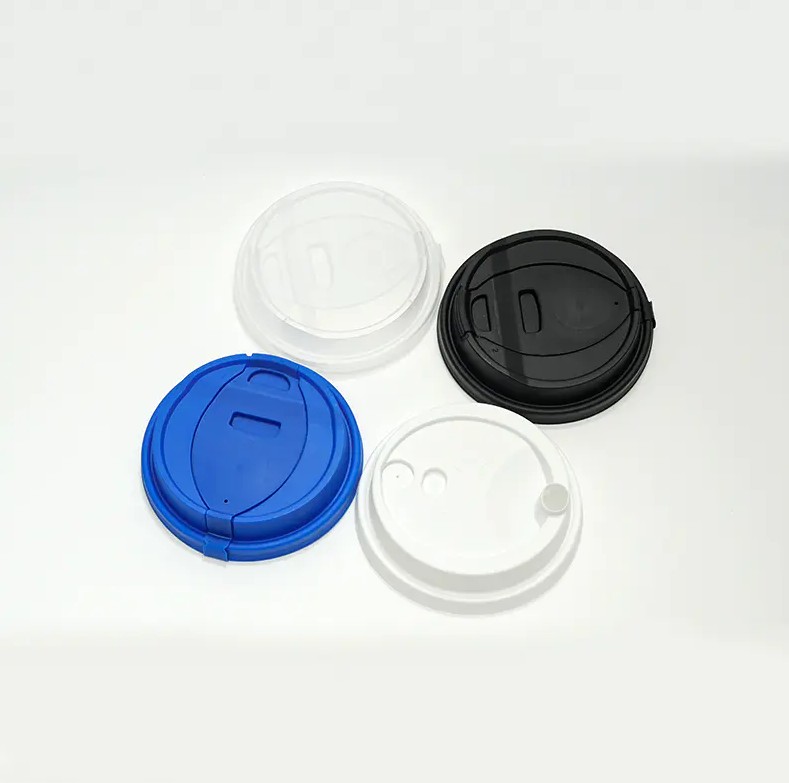
Customization Service Capabilities
Dimensional and Specification Customization
PP injection molded cup lids can be customized to various rim diameter specifications based on client requirements, commonly including 80mm, 90mm, 95mm, 98mm, and other standard cup rim sizes. Mold development cycles typically range from 25 to 35 days, with mass production daily capacities reaching tens of thousands of units after sample approval. Through dedicated mold development, the fit precision between lid and cup rim can be improved to ±0.1mm, significantly reducing snap-fit defect rates.
Appearance and Functional Customization
In terms of appearance customization, PP injection molded cup lids support multiple processes to achieve brand differentiation:
- Color customization: By adding food-grade color masterbatches, various effects including transparent, semi-transparent, and solid colors can be achieved, with color matching accuracy reaching 95% or higher
- Surface printing: Pad printing or screen printing on the lid top surface for brand logos or patterns, with print adhesion passing cross-hatch testing
- Functional structure customization: Special functional structures such as straw holes, anti-scald drinking ports, and stirring holes can be designed to meet specific beverage usage requirements
Application Scenarios and Market Demand
Primary Industry Application Distribution
PP injection molded cup lids have penetrated every sub-sector of the food and beverage industry. Based on market usage scenario analysis, the primary applications and their characteristics are as follows:
| Application Industry | Typical Lid Type | Core Requirements | Usage Frequency |
|---|---|---|---|
| Coffee Chains | High Dome / Flat Lid | Scald protection, brand display | Very High |
| Milk Tea Beverages | Dome Lid / Direct-Drink Lid | Compatibility with wide straws, leak-proof sealing | Very High |
| Fast Food Chains | Standard Flat Lid | Cost control, rapid snap-fit | High |
| Fresh Juice | Transparent Dome Lid | Content visibility, freshness perception | Medium-High |
| Convenience Store Retail | Universal Standard Lid | Multi-diameter compatibility, inventory simplification | Medium |
Market Growth Trends
With the continued expansion of food delivery markets and rising consumer awareness of food safety, demand for PP injection molded cup lids maintains steady growth. Between 2026 and 2030, the global food-grade injection molded cup lid market is projected to maintain an average annual growth rate of 6% to 8%. The Asia-Pacific region, driven by tea drinking culture and high food delivery penetration, is expected to outpace the global average growth rate.
Environmental Attributes and Sustainable Development
Material Recyclability
PP material belongs to the thermoplastic category, offering excellent recyclability and reusability. After use, PP injection molded cup lids can be sorted, cleaned, shredded, and pelletized for reprocessing into non-food-contact plastic products such as trash bins, flower pots, and industrial pallets. PP material ranks among the leading plastic types for recycling rates, with a theoretical recyclability of over 90%.
Environmental Measures in Production
During the production of PP injection molded cup lids, industry-leading enterprises have implemented multiple environmental measures: injection edge trim and defective products are crushed and re-blended into raw materials at controlled ratios (typically not exceeding 15%); production facilities are equipped with exhaust gas collection and treatment systems to ensure VOC emissions meet environmental standards; some enterprises have begun exploring bio-based PP materials or adding biodegradable additives to pursue more sustainable material alternatives.
Procurement and Usage Recommendations
Key Considerations for Purchasing
When selecting PP injection molded cup lid suppliers, food and beverage enterprises are advised to conduct comprehensive evaluations across the following dimensions:
- Complete qualifications: Verify whether the supplier holds food packaging production licenses and complete third-party testing reports
- Sample testing: Request samples for actual snap-fit testing, sealing testing, and drop testing
- Capacity matching: Confirm whether the supplier's daily production capacity and delivery lead times can accommodate business demand fluctuations
- Customization capability: Assess the supplier's mold development capability and design response speed
- Batch consistency: Examine the supplier's raw material sourcing stability and production process control level
Daily Usage and Storage Guidelines
To ensure optimal performance of PP injection molded cup lids, the following storage and usage guidelines are recommended: store in a cool, dry environment away from direct sunlight to prevent material aging and discoloration; limit stacking height to no more than 2 meters to prevent deformation of bottom-layer packaging; use opened lid packages within 30 days to avoid dust contamination; when using with hot beverages, confirm the lid's marked temperature limit to prevent deformation from overheating.




