


 English
 Español
 عربى
Content
- 1 What a Beverage Carrier Is Actually Asked to Do
- 2 Carrier Types and Where Each One Fails
- 3 Fit Starts With the Cup, Not the Carrier
- 4 The Lid Is What Usually Decides the Outcome
- 5 Matching Cup Material to Drink Temperature
- 6 Straws, Bags and the Rest of the Carry Chain
- 7 A Seven-Point Checklist Before You Commit
- 8 FAQ
Four 24 oz iced drinks leave the counter in a molded-pulp carrier. Ten minutes into the delivery, one cup has slid sideways in its well, the lid has lifted at the rim, and the pulp floor is soft under a film of condensation. The carrier's load rating was never the issue: the cup base was 2 mm narrower than the well, and the lid relied on a light friction fit.
That is how most carrier complaints begin. A beverage carrier, also called a drink carrier or cup carrier, is simply a device for carrying several filled cups at the same time, but on the road it behaves as a three-part system of cup, lid and carrier. Specify one part on its own and the other two will find the weakest point within a few hundred metres. The practical rule is straightforward: fix the cup and the lid first, then choose the carrier that matches their dimensions, weight and service conditions.
What a Beverage Carrier Is Actually Asked to Do
In principle a carrier only has to hold cups upright. In practice it has to survive five different loads, and most of them are forgotten during quoting.
- Static weight. A 16 oz cup of soft drink with ice, cup and lid weighs roughly 500 to 550 g. Four of them put about 2.2 kg on the well bottoms before anyone even lifts the carrier.
- Dynamic load. Walking, stairs and vehicle suspension multiply that figure. A 0.8 m drop onto a hard floor is a common internal acceptance test for takeaway carriers.
- Moisture. Cold cups sweat. Molded pulp and paperboard lose stiffness quickly once the well walls take up water, while thermoformed plastic keeps its shape.
- Balance. One-hand carry means the centre of gravity must sit almost directly under the fingers; a single off-centre 24 oz cup is enough to tip a four-cup carrier.
- Bag and stack clearance. Carriers are normally bagged, sometimes two high, so overall height, nesting depth and handle height all change how the order arrives.
None of these loads can be solved by the carrier alone. A carrier distributes weight; it cannot stop a loose lid from lifting or a narrow cup base from rattling inside an oversized well.
Carrier Types and Where Each One Fails
Most carriers in commercial use fall into five constructions, and each one has a characteristic failure mode that shows up in delivery data long before it shows up in a catalogue.
| Construction | Wet behaviour | Typical format | Most common failure |
|---|---|---|---|
| Molded pulp | Rigid when dry, softens as it absorbs moisture | 2 to 4 cups, counter takeaway | Well walls sag under condensation |
| Die-cut corrugated board | Light and printable, weak grain direction | 2 to 4 cups, lighter drinks | Handle tears along the grain |
| Thermoformed PP | Water resistant, dimensionally stable | 2 to 6 cups, high-volume delivery | Wells crack if cup diameters vary |
| Clear PET sheet | Thin gauge, good product visibility | 2 to 4 cups, cold drinks | Brittle in cold rooms, sharp edges after impact |
| Reusable EVA or nonwoven | Thick walls, washable | 4 to 6 cups, catering and events | Return logistics and cleaning cost |
For cold drinks moving through delivery, thermoformed PP is usually the safer default: it tolerates condensation, holds its well diameter after repeated handling, and does not collapse when a bag is pressed on top of it. Molded pulp remains the better choice for short, dry counter hand-offs where cost per unit dominates.
Fit Starts With the Cup, Not the Carrier
Carrier catalogues are organised by cup count, but every dimension that decides whether an order arrives intact is measured on the cup.
- Rim diameter and lip thickness decide whether the cup can sit in a top-load well or needs a base-in design.
- Base diameter sets the well floor size; 1 mm of slack at the base becomes visible wobble at the rim.
- Height with the lid on determines carrier depth and whether the bag closes without pressing on the lid.
- Taper angle controls how deep the cup seats. A shallow taper sits higher and tips more easily.
Tolerance is where purchase risk hides. A rim tolerance of plus or minus 0.3 to 0.5 mm is normal for thermoformed cups, so a carrier tooled to the nominal diameter can end up with 1 mm of slop on a heavy production run. Measure at least twenty cups from a production batch rather than one sample from a sales kit, and measure them with the lid fitted.
For cold drinks the common pairing is a clear PET cup with a matching PET lid. The wall is rigid, the clarity sells the drink, and the carrier well only needs a base diameter that matches the cup base within roughly a millimetre.
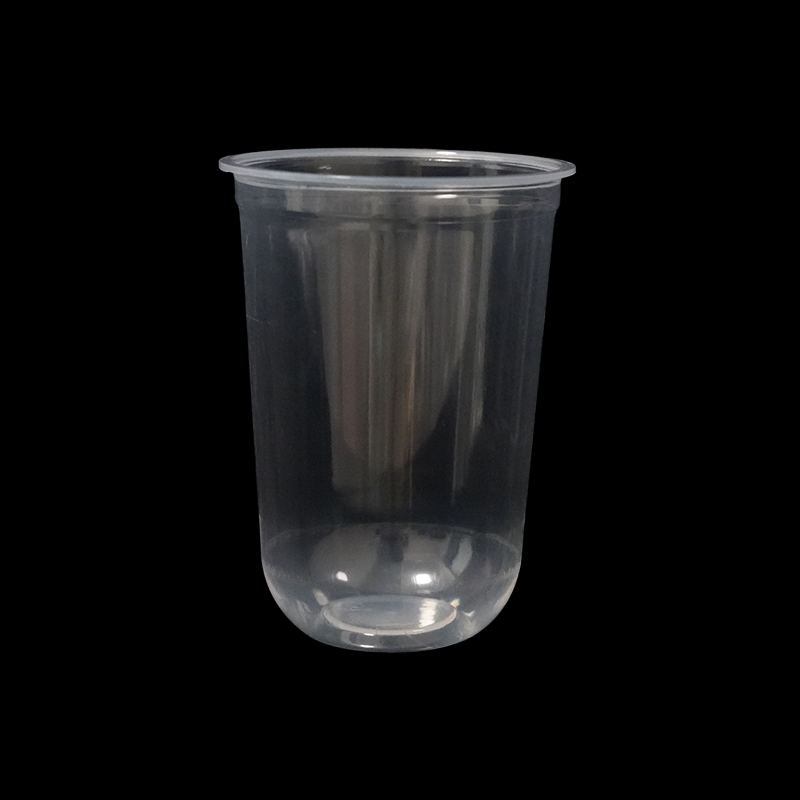 Customizable Food-Grade PET Drink CupsCold-drink PET cups in 500 ml and 700 ml sizes with 90 mm mouths, stackable and customizable with logos for branded beverage service.View Product →
The Lid Is What Usually Decides the Outcome
Anyone who handles delivery complaints sees the same pattern: the carrier gets the blame and the lid is the cause. Cup retention inside a carrier is largely a question of geometry, but liquid retention is a question of lid design and how the lid engages the rim.
A friction plug lid relies on the elasticity of the plastic to stay seated. It works well for a drink consumed in ten minutes and badly for a drink that spends twenty minutes on a scooter. A lid that mechanically overlaps the cup rim, with a reinforced rim band and a defined snap, resists side impact and internal pressure far better, which is why patented leakproof designs exist as a separate product family rather than a variant of a standard lid.
Drink style then decides the lid format. A dome or ball lid leaves headroom for toppings and ice cream, a direct-drink lid serves sipping without a straw, and a flat lid seals and stacks best in a bag. Dual-purpose hole designs cover both straw use and direct drinking, which reduces the number of SKUs a shop has to stock.
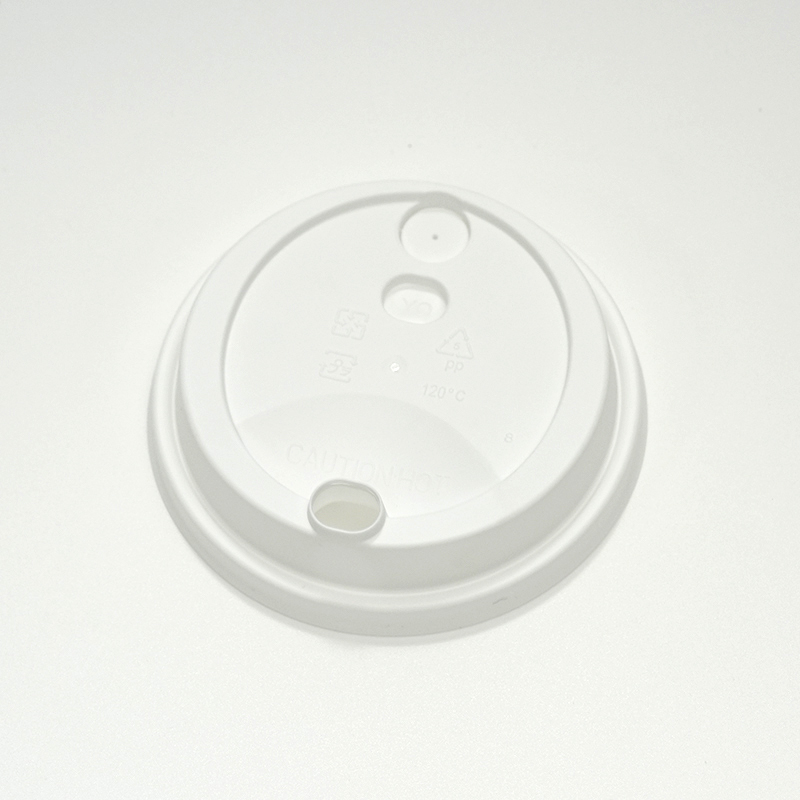 Patented Leak-Proof Plastic Cup LidsThickened 80 mm and 90 mm flip and flat lids with leak-proof structure, available in black or white and customizable for beverage brands.View Product →
Matching Cup Material to Drink Temperature
PET is the natural choice for cold and iced drinks: transparent, rigid, and stable at low temperature. Its weakness is heat, so it should not be used where fill temperatures climb. PP handles hot filling and keeps its stiffness when a lid is pressed on, which matters more than the small unit-price difference once a shop is running sealed cups through a busy counter.
The wall stiffness of an injection-molded cup also lowers the centre of gravity when the base is weighted, and that changes how the carrier behaves. The advantages of PP injection-molded cups for food packaging come down to heat resistance and dimensional stability rather than cost alone, and those two properties are exactly what a carrier relies on.
Temperature also changes the carrier's job. A hot, dry cup is gentle on a pulp carrier; a cold cup in a humid room is not, because condensation wicks into the well walls within minutes. If the same carrier is used for both, choose the construction that survives the colder case.
Straws, Bags and the Rest of the Carry Chain
The straw slot is a small detail with a measurable effect: a slot cut for a 6 mm straw will grip a 10 mm bubble tea straw and tear, while an oversized slot lets the straw fall through into the bag. Paper straws soften over a long drink, and PLA straws need industrial composting conditions to break down, so the straw choice should match both the drink's expected duration and the disposal route the customer actually has.
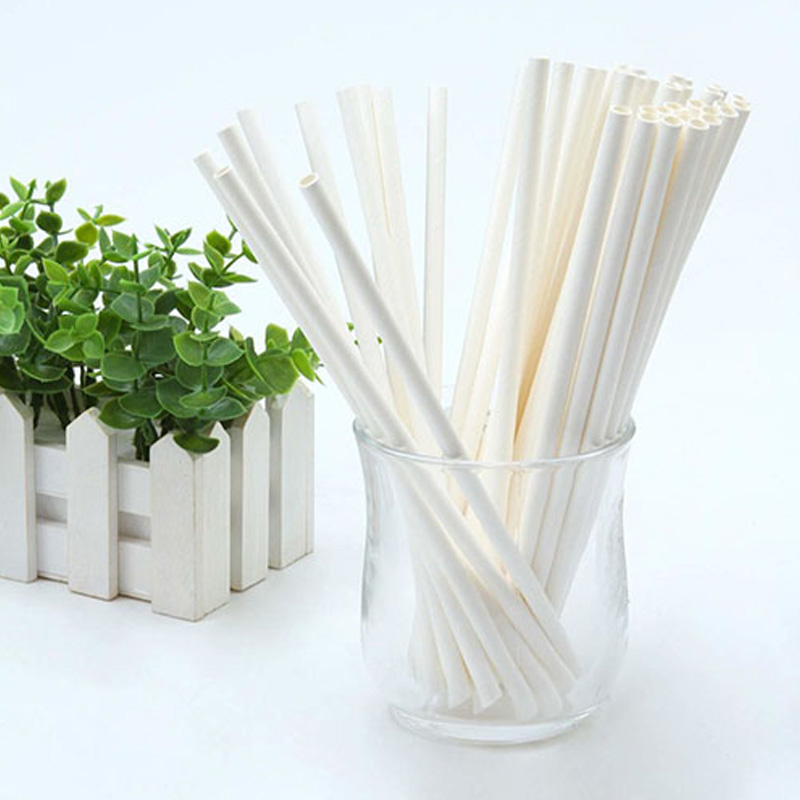 Customizable Biodegradable PLA Drinking StrawsIndividually paper-wrapped PLA straws in multiple diameters and lengths, supporting multi-color logo printing for environmentally focused beverage service.View Product →
Finally, the bag. A carrier bag has to carry the loaded carrier without the handles stretching, and for multi-order dispatches a heavier gauge recyclable PE bag or a biodegradable PLA packaging bag is usually a better fit than a thin retail bag that was never designed for 2 kg of liquid.
A Seven-Point Checklist Before You Commit
- Measure at least twenty cups from a live batch: rim diameter, base diameter, height with the lid fitted.
- Weigh the heaviest real drink, including ice, fruit and toppings, not the nominal fill volume.
- Run a 0.8 m drop test on a hard floor, side impact and corner impact, with the carrier fully loaded.
- Hold a cold cup at 4 °C for thirty minutes and check whether the well walls soften or stain.
- Lift the loaded carrier by the lid to confirm the lid, not the carrier, is holding the cup.
- Bag two carriers together and check height clearance and handle strength.
- Check incoming moisture content and shelf life for pulp and board stock, since humid storage quietly removes strength.
FAQ
Is a beverage carrier the same as a cup holder?
Not quite. A cup holder usually supports a single cup, often in a vehicle or on a machine, while a beverage carrier is designed to move several filled cups at once by hand.
Can one carrier fit different cup sizes?
Some designs use stepped or slotted wells to accept two rim diameters, but mixing a 16 oz and a 24 oz cup in the same carrier shifts the centre of gravity and increases tipping, so matching sizes within one carrier is safer.
Are molded pulp carriers recyclable?
Yes, when they are clean and dry. Once a pulp carrier has absorbed drink or condensation it is normally treated as contaminated and goes to general waste, which is one reason plastic carriers persist in wet delivery chains.
Do I really need a leakproof lid for delivery?
For shaken, layered or milk-based drinks, yes. The lid, not the carrier, decides whether the liquid stays in the cup, and a mechanically locking lid costs far less than a remake and a refund.
How many cups per carrier should a delivery order use?
Two to four is the practical range for one-hand carry. Beyond four large cups the loaded weight and the reach both work against the rider, and splitting into two carriers is usually faster than recovering a dropped order.
TOPCUP, operated by Yuqian Packaging Technology (Jiangsu) Co., Ltd., produces disposable food packaging from a 30,000 m² facility in Taizhou, Jiangsu, with a Shanghai branch established in 2019. The range covers PET and PP cups, patented leakproof lids, takeaway bowls and liners, straws and packaging bags, supported by QS, ISO9001, BRC, DIN and ROHS documentation. If you are matching a cup, lid and carrier for a specific drink format, send the dimensions and fill weight to the team and they will confirm the fit before tooling is discussed.



